
... preludes and fugues in all tones and semitones, including both the major third, or ut re mi, than the minor third, or king makes me…
The terms “prelude” and “fugue”, in the collective imagination, they tend to be easily associated with the name of Johann Sebastian Bach. This isn't too surprising, considering the "popular" notoriety he has gained The Well-Tempered Clavier (It's not uncommon to hear cell phone ringtones play a simplified version of the first one Prelude of the First Book). However, this does not mean that the awareness of what a "prelude" and a "fugue" are is equally widespread. It is not difficult, But, get at least a general idea.
The term “prelude” indicates a musical composition that introduces or anticipates another. In the case of CBT, the consideration is undeniably correct (every prelude precedes a fugue); however, they exist, in the history of music, cases of isolated preludes, like those made by Chopin or Rachmaninoff; however these are works much later than Bach.
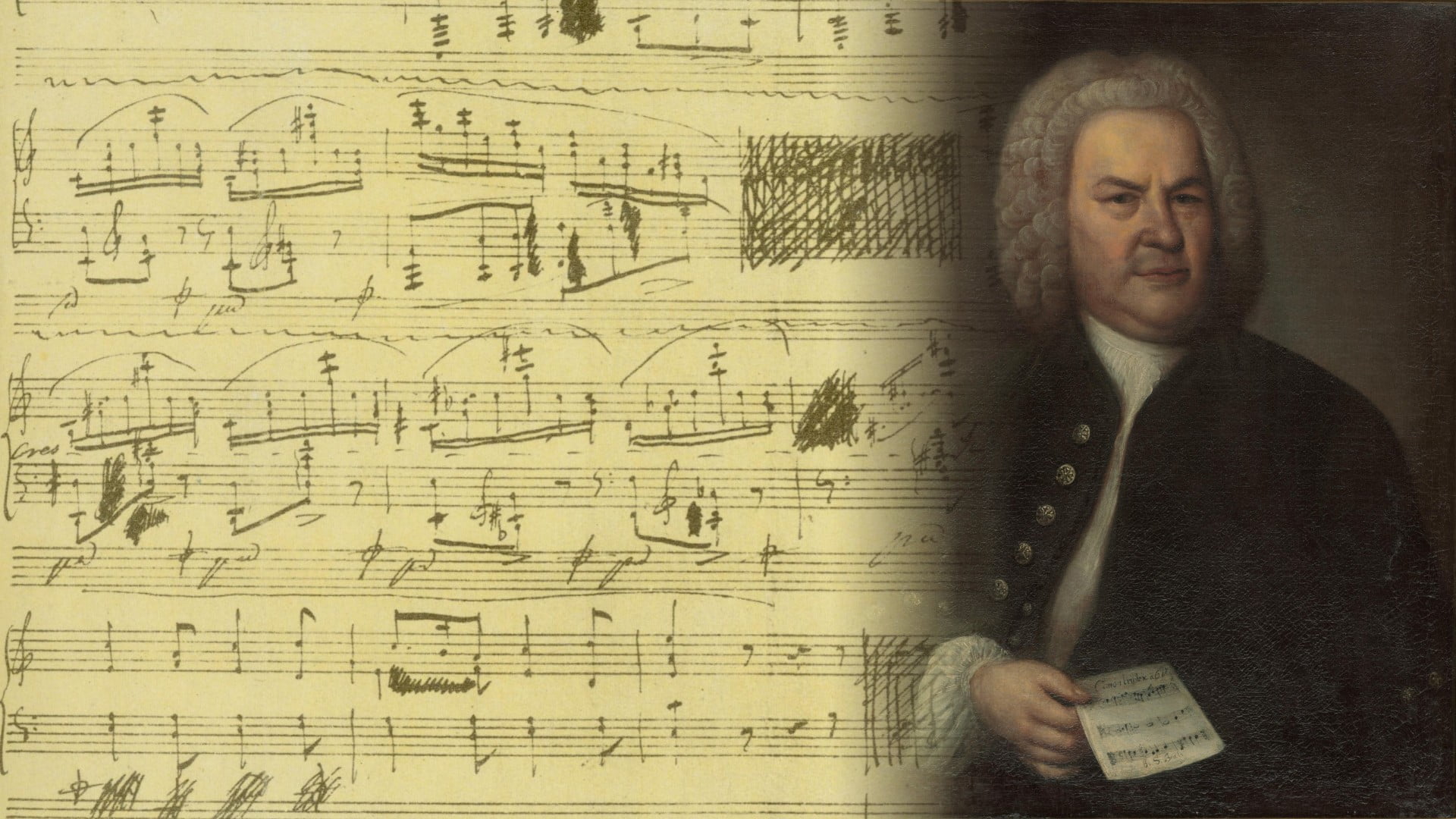
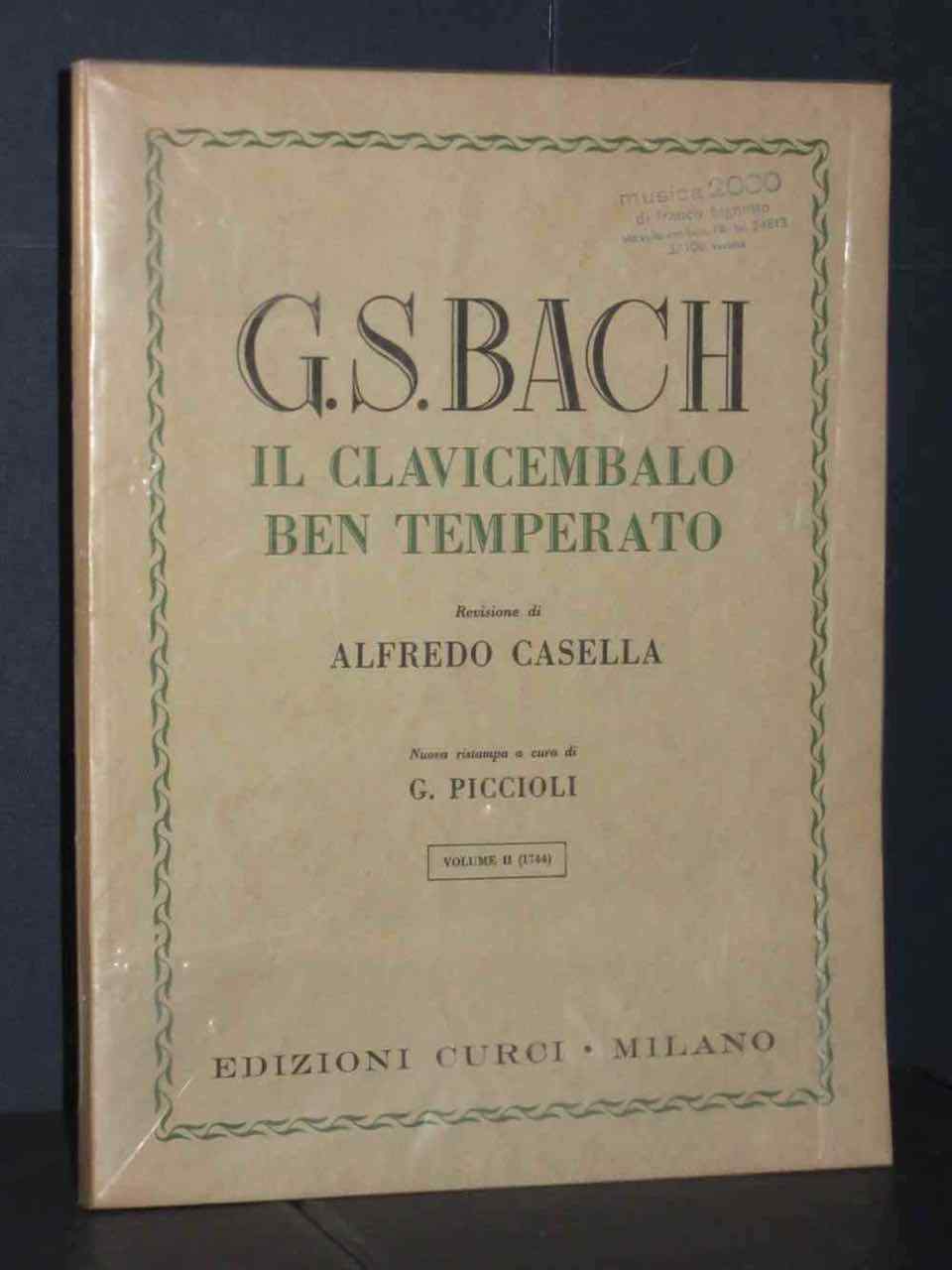
There is no official “birth certificate” for the prelude. The roots of this musical form are not found in a clearly identifiable method of composition, but rather in a practice executive, widespread as early as the 15th century but certainly also present in previous periods: improvisation. This practice was particularly linked to stringed and keyboard instruments; its functions could be various, including the tuning test, the “warm-up” before a performance, o, more often, the introduction of the right harmonic tone which would then concern the following piece, useful for the right intonation of a choir or other instruments. Despite the total freedom of the performer, however, there was a natural tendency to use predominantly extemporaneous arrangements with a variable degree of decoration and "flourishments".
It was in the 16th century that these improvisational intonations began to take on more defined and fixed forms on the page, taking the name of preambulum o intonation. Forms properly called "prelude", however, developed only in 1600, while always maintaining that degree of "indeterminacy" given to them by improvisational practice. For example, several French preludes from the period in question are not written in metrical form; the notes are only partially reported, the rhythmic values are not indicated and the durations are only sketched.
From 1600, and then in the 18th century, the preludes become increasingly conventional pieces, that is, large, accurate and disciplinedly elaborate constructions. This was also due to the evolution of the genre in areas that were not strictly solo, as in the case of introductions to operas (this opening or symphonies), or the slow movements placed at the beginning of the chamber sonatas. It is interesting to note the natural union that was established between prelude and fugue, in the instrumental field, which anticipated Bach's conception of this diptych. Especially in Northern German keyboard music, the term “prelude and fugue” began to indicate not two distinct pieces, but a single composition with a mixed character (for example in Dietrich Buxtehude, one of Bach's most important ancestors). Only slowly did the two songs separate, while remaining conceptually bound. The effects of this separation led to collections such as the one already mentioned Ariadne musica by Fischer.
The historical path of the escape is much more complex, which cannot be summarized now; instead, it may be more useful to give some hints here on the structure of the fugue itself, which is one more than a form technique compositional.
Linked to the term "fugue" are often the indications "three voices", “for four voices”, and similar. The indication refers to the number of independent melodic lines present and overlapping within the piece. Obviously, the composer's commitment increases proportionally to the number of voices. Such rumors, Indeed, they must be linked to each other, harmonically and thematically. From the point of view of the theme, they all contribute to developing a melodic and rhythmic inspiration with its own character: the so-called subject of escape. It's very easy to spot, at least in principle. In fact, the voices enter one by one, in later times: therefore at the entrance of the first voice there are no other melodic lines present. The individual notes that are heard are precisely the constituents of the subject. The entry of the second entry proposes the same subject (while the first continues with a countersubject), however with a harmonious bond; the subject is intoned starting five notes higher (or four lower), to a fifth higher, so (lower fourth). The next entry presents the subject in its original version, and so on. Once the entry of all entries is complete, it can be said that theexposure of an escape is over. Generally at this point the first of those so-called connecting episodes occurs entertainment, who prepare a subsequent exposition with a certain degree of freedom. The entertainment, specie in Bach, they can also have a high importance in the construction of an escape. There are also many contrapuntal devices that the artist can use in the continuation of the musical discourse (canons, inversions…). Here we only point it out strict, which generally introduces the conclusion of the fugue. This is the final entry of all entries, however at a close distance from a temporal point of view, compared to exposure. The composer must be able to foresee the strait from the beginning, to construct a subject that can overlap itself in this way, without causing too harsh dissonances or other harmonic errors.
The one presented here is, naturally, an extreme simplification of the structure of the fugue. It should also be considered that very often certain authors, and specifically Bach, they clearly had a natural predisposition for creating escapes, thus giving an indispensable spontaneity to a creation process that would otherwise have been unbearably "scholastic" and cold. It is believed that Bach even managed to conceive his fugues in one act, a single "musical thought" that initially envisaged all the possible combinations between subject and countersubject. This is clearly hyperbole, but perhaps this is not so far from the truth.
Finally, it should be noted that the combination of a specific prelude with a specific fugue, In the CBT, it almost never depends on thematic links. The pieces can even be very different in character: just listen to the Prelude and fugue n. 7 of the First Book to realize this. The fundamental link remains only the harmonic-tonal one; the pieces, However, they would make no sense if performed alone, without the other component of the diptych, also given the historical tradition from which the organization that Bach gave to the descends CBT.
The well-tempered keyboard…
The wording "well-tempered" that appears in the title of the work may appear obscure, but in reality it refers to a concept that is relatively easy to understand. The “temperament” of the keyboard, Indeed, it is nothing other than the division of the musical octave into twelve equal parts. This measure is also called "equal temperament", and has the disadvantage of making all the intervals that can be achieved on the keyboard slightly different from the "natural" intervals, given by simple numerical ratios between the frequencies of sounds (for example, 1/2 corresponds to the octave, 2/3 to the fifth, and so on according to a scheme that seems to have been discovered and constructed by Pythagoras). However, with equal temperament it becomes possible to transpose a song into any key, that is, choosing any note to start with and then adapting the subsequent ones accordingly, respecting the intervals given initially. And from this immediately follows the possibility of composing a song in any key, not giving any impression of artificiality, as Bach's work demonstrates.
There is another problem with the title. The Italian translation “The Well-Tempered Clavier” is substantially incorrect, as well as the readings “Le clavecin bien temperé”, o “The Well-Tempered Clavichord”. The fundamental problem with these translations is the explicit reference to a musical instrument (the harpsichord, the clavichord) when the German original (Keyboard) refers generically to one part of an instrument, i.e. the keyboard. This linguistic fact refers to a more general question related to CBT: what was the instrument to which Bach intended his work? The question has no answer. Generally, Bach's keyboard music never has a specific destination; the wording is usual for piano (even if there are rare cases of indication "for harpsichord" or "for organ"). Complications in the interpretation of Bach's titles have arisen since 1753 (Bach, remember, died in 1750), year of publication of Method essay for keyboard di Carl Philipp Emanuel Bach; already in that period, the term Keyboard it was now reserved for the clavichord alone, leaving the identification of the harpsichord with terms such as Clavicimbel, o wing, o wedge wing. Furthermore, the harpsichord and the clavichord were not the only keyboard instruments with which the CBT; important considerations concerned the organ, for example, based on elements of style in the writing of some Preludes and fugue. Concretely this can be found in Leak in A minor of the First Book, where a pedal on a held A, at the joke 83, it spontaneously makes one think of organ writing rather than harpsichord writing.
The ever-increasing fortune of the piano starting from the end of the eighteenth century, Then, he proposed new questions of a philological nature, on the legitimacy or otherwise of the interpretation of the CBT on this tool. However, it seems extremely unlikely, if not impossible, that Bach may have had the piano in mind when writing his preludes and fugues. However, the composer was not unaware of the existence of this further "keyboard", among the many available. Indeed, he had the opportunity to try fifteen different Silbermann pianos at the court of King Frederick the Great of Prussia., even going so far as to improvise on one of them a fugue for six voices on a subject proposed by the king. The subject was what would later become the basis for The musical offering; but the indication regarding this almost miraculous improvisation is probably an exaggeration of the Bach biographer who reported this information, Johann Nikolaus Forkel. In another account of a baron, Gottfried van Swieten, the improvisation would even have been for eight voices, thing that, Rationally, it goes beyond human capabilities. The fundamental point is that Bach knew the piano, and so what, in general, an execution of CBT on this instrument it could even have a certain legitimacy.
But each of the arguments presented so far is not decisive, and the matter is naturally predisposed to continue forever. There is perhaps only one sensible evaluation in this regard, now commonly accepted by most performers of the CBT. Kirkpatrick explains this idea well, with his words: «I believe it is impossible to irrefutably argue that any part of the CBT is intended exclusively for a specific keyboard instrument, be it the harpsichord, the clavichord or the organ. The historical and stylistic evidence lends itself to arguments in several directions, none of which are conclusive. Preludes and fugues are works that take on different aspects depending on the instrument on which they are performed. Even more, their implications go far beyond the confines of any keyboard instrument. Just like a drawing is often the sketch of a painting, thus many of the fugues are sketches of choral works. Just as a drawing in a painter's album can prefigure an enormous fresco, thus a CBT leak can foreshadow a massive one Kyrie. The company, apparently ridiculous, to entrust the four or five voices of a vocal fugue, which requires continuous sound from a plucked string keyboard instrument, it is explained if we understand that suggestion, as in poetry and the figurative arts, can sometimes be more expressive and stimulating to the imagination than a complete work.".
Marco Bellano